Be yourself; Everyone else is already taken.
— Oscar Wilde.
This is the first post on my new blog. I’m just getting this new blog going, so stay tuned for more. Subscribe below to get notified when I post new updates.
Be yourself; Everyone else is already taken.
— Oscar Wilde.
This is the first post on my new blog. I’m just getting this new blog going, so stay tuned for more. Subscribe below to get notified when I post new updates.
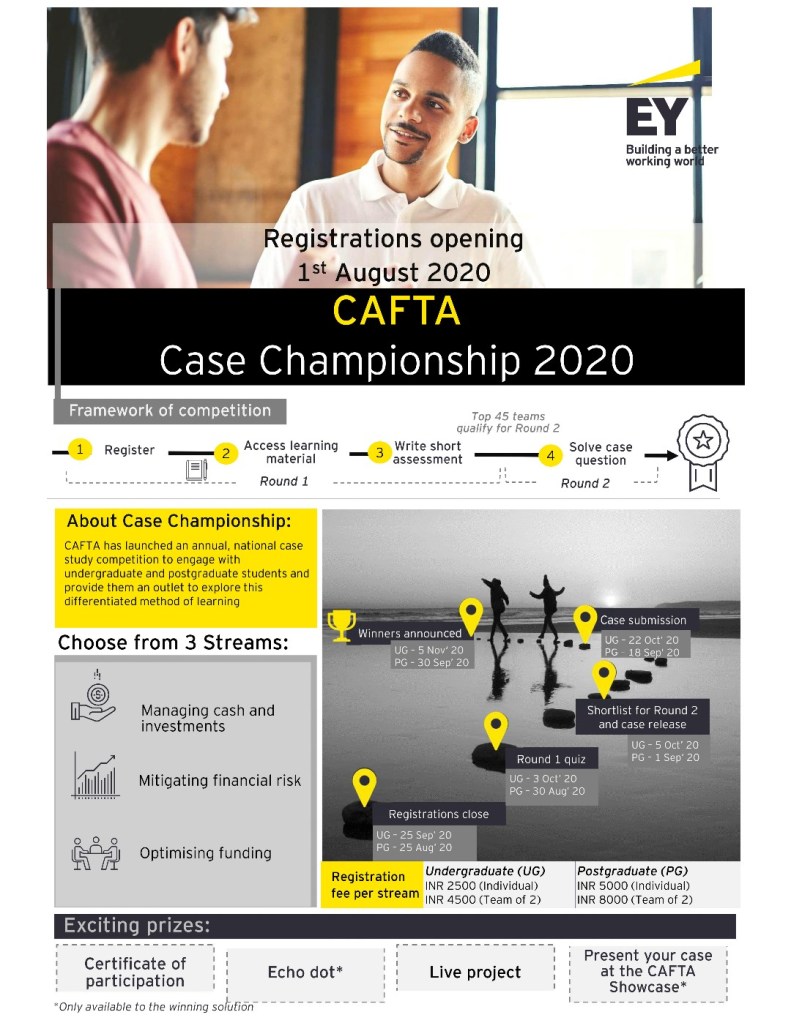
Want to make your career in consulting? Do you get excited when this word pops up? Has #Consulting always been your dream?
EY has come up with CAFTA Case Championship 2020 for young, bright minds like you to solve consulting cases, especially curated by EY professionals.
So, you not only get the opportunity to support EY experts in their ongoing consulting cases, but also the opportunity to present your case to them as well as at the EY Showcase Event.
Sounds exciting? Brace yourselves for EY CAFTA CASE CHAMPIONSHIP 2020!
For more information, visit:
Follow the hashtag #EYCAFTACC2020 to stay updated!
#bschool #bschoolcompetitions #dare2compete #EY #EYCAFTA #EYCAFTACC2020 #casestudycompetition #Consulting #finance #casestudy #corporatefinance #treasury #casesoultion #consultingcase #casecompetition #casecompetition #internships #liveproject #opportunity
If you’re an avid reader of finance, kinda person follow this space RiskManagement for financial news .
INTRODUCTION:
Financial Risk Management is the process of identification, analysis and mitigation of uncertainty in investment decisions. Risk management is a much-needed core competency that helps organizations deliver and increase stakeholder value over time. A good risk management requires better data and information, so organizations can take action on an ever-evolving inventory of risks. Predictive risk information can give management a leg-up in making better-informed decisions and help them take actions that produce outcomes that are more reliable. Evolution in computing and risk technology, and related developments in new technologies that exploit Big Data, Analytics, Mobile Applications, and Governance, Risk, and Compliance systems (GRC), are also important for risk management. These technical advancements help risk managers in improving existing risk management programs for enhancing risk management effectiveness.
MANAGING RISK USING TECHNOLOGIES:
Big data provides an alternative approach to building scalable solutions because the time required to manage the data is reduced. Using big data, calculations are moved to the data instead of moving the data to the calculations, greatly reducing overall run times. Big data also provides resiliency to mission-critical applications because redundancy and fault tolerance are built into the software framework. By design, multiple copies of all file blocks are stored on the file system so, if a disk drive crashes or a node dies, jobs can be simply rerun using another copy of the data. AI is the face of the future and is changing the way organizations conduct business. In the financial environment, cognitive capabilities can help you act faster and with greater confidence. Natural language processing (NLP) helps you understand patterns and connections in the news and blogs—it even identifies changing sentiments—before they hit the news. Cognitive technology can be used to uncover patterns in identifying new stress-testing scenarios—and faster than ever before. The potential for AI in financial applications is limitless. When looking specifically at the field of risk management, there are several potential applications for AI that stand out. First of all, ML can be applied to labor intensive jobs, such as cleaning data to improve data quality. A second potential application is processing unstructured data in the form of written articles and live feeds for interesting news that’s related to a portfolio. Natural language processes, combined with sentiment analysis, can help firms take unstructured data and create scenarios that are relevant to one or more investments. Block chain is being viewed as the foundational technology for the future of risk management. The block chain peer-to-peer framework offers the potential to transform current business processes by disintermediating central entities or processes, improving efficiencies, and creating an immutable audit trail of transactions. This will help to lower costs, decrease interaction or settlement times, and improve transparency for all parties. Block chain technology will transform business models from a human-based trust model to an algorithm-based trust model, which might expose firms to risks that they have not encountered before. In order to avoid such risks, firms should consider establishing a robust risk management strategy, governance, and controls framework.
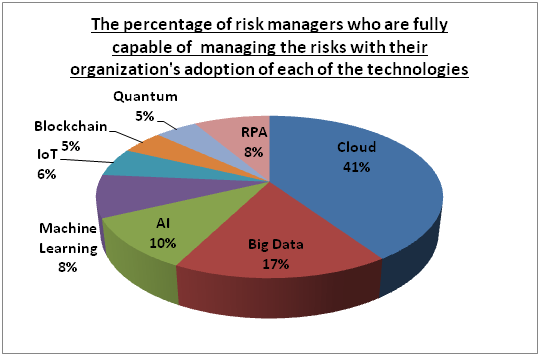
For example, in case of block chain technologies, there are private block chains where there are regulators present on the network. That regulator could have its chain permissions set so that it is only able to view transactions that are in a specific state. In contrast, a business participant in the block chain will only be able to transact with non-regulator parties and not be able to view or action transactions that is not party to. So, private block chains may create less risky environment.
CONCLUSION:
Although the business requirements facing firms related to financial risk management are increasing, so are the ways to address them. The technology that can be applied to the field of financial risk management is changing extremely rapidly. Attempting to keep abreast of the constantly evolving technologies can be overwhelming, and frankly, intimidating. Big data can dramatically reduce run times by reducing data moves while building in redundancy and fault tolerance at the same time. AI can help incorporate unstructured data into the risk processes, as well as aid in data cleaning. So, as the future of finance will have more use of technology, managing financial risks would be simpler.
This is an example post, originally published as part of Blogging University. Enroll in one of our ten programs, and start your blog right.
You’re going to publish a post today. Don’t worry about how your blog looks. Don’t worry if you haven’t given it a name yet, or you’re feeling overwhelmed. Just click the “New Post” button, and tell us why you’re here.
Why do this?
The post can be short or long, a personal intro to your life or a bloggy mission statement, a manifesto for the future or a simple outline of your the types of things you hope to publish.
To help you get started, here are a few questions:
You’re not locked into any of this; one of the wonderful things about blogs is how they constantly evolve as we learn, grow, and interact with one another — but it’s good to know where and why you started, and articulating your goals may just give you a few other post ideas.
Can’t think how to get started? Just write the first thing that pops into your head. Anne Lamott, author of a book on writing we love, says that you need to give yourself permission to write a “crappy first draft”. Anne makes a great point — just start writing, and worry about editing it later.
When you’re ready to publish, give your post three to five tags that describe your blog’s focus — writing, photography, fiction, parenting, food, cars, movies, sports, whatever. These tags will help others who care about your topics find you in the Reader. Make sure one of the tags is “zerotohero,” so other new bloggers can find you, too.
Have a WordPress.com account? Log in now.

